

Bridges Worth Defending
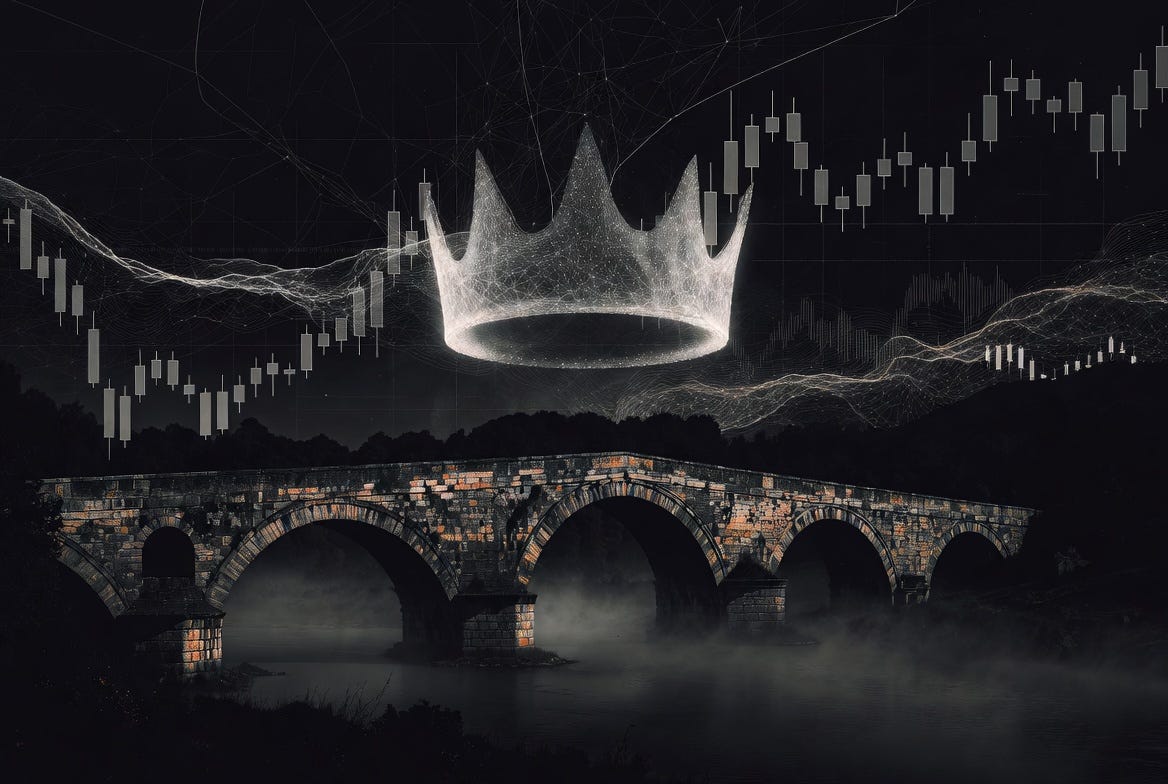
“Now who will stand on either hand, and keep the bridge with me?”
Lord Macaulay “Horatius”
About a year ago, three glasses of wine ruined a podcaster’s life.
His sleep score tanked. He didn’t go to the gym for two days. Worst of all, his next podcast episode was recorded poorly. Steve Bartlett, the man behind the wildly successful Diary of a CEO, has a life so holy that any amount of alcohol can ruin it. Gen Z is drinking less because their lives, like Bartlett’s, are too holy.
I know a girl who woke up in her dorm room with a cough, promptly threw away all her alcohol and bulk-ordered magnesium supplements. Getting a minor cold inside a college dormitory is intolerable because the part of your spirit that resides online never gets sick. Succumbing to the infections of mere mortals is not part of the deal. So, she asks the God she doesn’t believe in to eradicate her disease: 5 am runs, perfect skincare, an optimized life from sunrise to sundown until the day she lies down for her ten-hour rest and never wakes up.
That most of these people call themselves atheists is beside the point. Gen Z is quitting drinking for the same reason Odysseus sacrificed to Zeus. They believe in an internet-native God and will do anything to appease Him. If I can become so pure, my life so optimized, then perhaps the algorithm will choose me.
People fail to comprehend the internet-native God because they view the internet as instrumental. A tool geared toward the real world. Social media is a fundamentally different dynamic: Your embodied life in the real world is instrumentally useful to curate your fake life online. Your island vacation was in service of the Instagram post you made there. So are the clothes you bought and the workout program you completed. Everything is devotional to the algorithm.
The algorithm requires sacrifices that are aspirational as much as they are physical. I once had a classmate tell me he wanted to do “M&A for Goldman Sachs”, even though he didn’t know what it stood for. Social media convinced him life would not be complete until he worked this oddly specific job in an industry he knew nothing about, and he followed along because the algorithm can’t be wrong.
The magnesium girl engages in ritual sacrifice for the same reason the M&A kid will one day endure 100-hour work weeks. All of this is hard, but nothing is being built or created. It’s devotion not to a thing that outlasts us, but to an abstraction that exists only at this very moment. Fame, fortune, beauty – it’s all about you, and the return you expect to receive.
When King Charles changed his coronation oath earlier this summer from “Defender of the Faith” to “Protector of the Space for Faith within the Multi-faith Nation,” it barely made headlines.
Most people hardly think about the British monarchy at all, and when they do, they view it as a dying institution without serious political weight. That may be true. But it’s also true that the crown used to represent a People, embodying all their history and glory into one face. That face was the “Defender of the Faith” because the Faith, at least since 1688, was worth protecting.
And the Faith was real. It had a history – people died for the Faith. In Their Finest Hour, Churchill remarked, “Upon this battle depends the survival of Christian civilization. Upon it depends our own British life, and the long continuity of our institutions and our Empire.” In other words, there are things worth dying for because they are real and enduring.
The internet-native God is neither real nor enduring. Same with the Space for Faith. Both are derived from other things, hidden behind so many layers of abstraction that you forget they exist. Those things are what actually matter – People, history, culture, life – all of which are being abstracted away into irrelevance. You can no longer have a life offline, so you embrace one online. You no longer have the Faith, so you worship the space for it.
This essay is not, strictly speaking, about the internet or the British monarchy. It’s about how we deify abstractions until they become the only things left.
There’s a scene in the movie Margin Call in which, on the eve of the 2008 Financial Crisis, a recently fired banker named Eric Dale reminisces about the time he built a bridge. It spanned from Dilles Bottom, Ohio to Moundsville, West Virginia, and saved the people of those two communities a combined 1,531 years’ worth of driving. Dale then brought his engineering background to Wall Street, and never built anything again.
Margin Call’s central question is not why the economy collapsed, but why bridge builders became investment bankers. It’s about the steps removed we become from the real, true, and beautiful. The bridge is sacred because it was built to serve people and still does, while the mortgage-backed security is a pure abstraction because it is value derived from value, traceable at some level back to something built.
Because the abstraction, in this case complex financial products, became the goal, people stopped considering the original source of value it came from. The stock market blew up after people foreclosed on their homes. Nobody saw it coming because nobody thought that the abstraction was in any way tied to the real world. It was supernatural, or if you prefer a different word, divine.
The internet-native God, the coronation oath, and 2008 are different threads of the same story. Social media abstracts away your embodied life, politics abstracts away the history of your people, and finance capitalism abstracts away real value into something derivative and ultimately worthless.
No one voted for any of this, nobody was even told it was happening, a chain of unrelated things are shaping our lives in a way that feels both involuntary and causal. It’s layers of abstraction all the way down.
The debate over artificial intelligence brings all this to bear.
When the marginal cost of intelligence approaches zero, so does the cost of abstraction. AI can post on social media and complete accounting spreadsheets, but its power currently ends where embodiment begins. It can’t live your life for you, and that might be its only limitation.
The bad news is that AI will let you live a nearly unembodied reality. You can choose to be conscious in name only, outsourcing all your thinking to the machine and keeping only your physical impulses. AI, used like this, will sever the abstraction from its source. It will remove life from the perception of life.
The alternative is to double down on embodiment. The glass of wine and the faith, anything with value derived from your embodied experiences with it. That’s why restaurants will survive AI in a way consulting firms won’t, because they produce experiences rather than slide decks. The non-automated businesses will be those least tainted by abstraction. A bartender knowing your drink before you even sit down will still be priceless.
There is also another thing model weights can’t capture. The epigraph of this essay tells the story of a Roman hero, Horatius Cocles, who defends the Sublician Bridge against the entire Etruscan army.
Nobody cares what his sleep score was, and no one stops to think whether defending the bridge was the right thing to do. Perhaps Horatius should’ve defended the space for bridges in the multi-bridge nation. The only thing we know is that the bridge was real, and so was Rome, so Horatius risked his life defending it.
There is no immortality on the internet, in the British monarchy, or on Wall Street. There is no immortality in this life at all, no matter what your sleep score is. All we have is the bridge.
In a world marred by abstraction, the bridge is still worth defending.
“Now who will stand on either hand, and keep the bridge with me?”
Lord Macaulay “Horatius”
 | A guest post by
|