

Love-Hate Triangle: The Trilateral Future of Japan, South Korea, and the U.S.
The Past and Future of East Asian Diplomacy
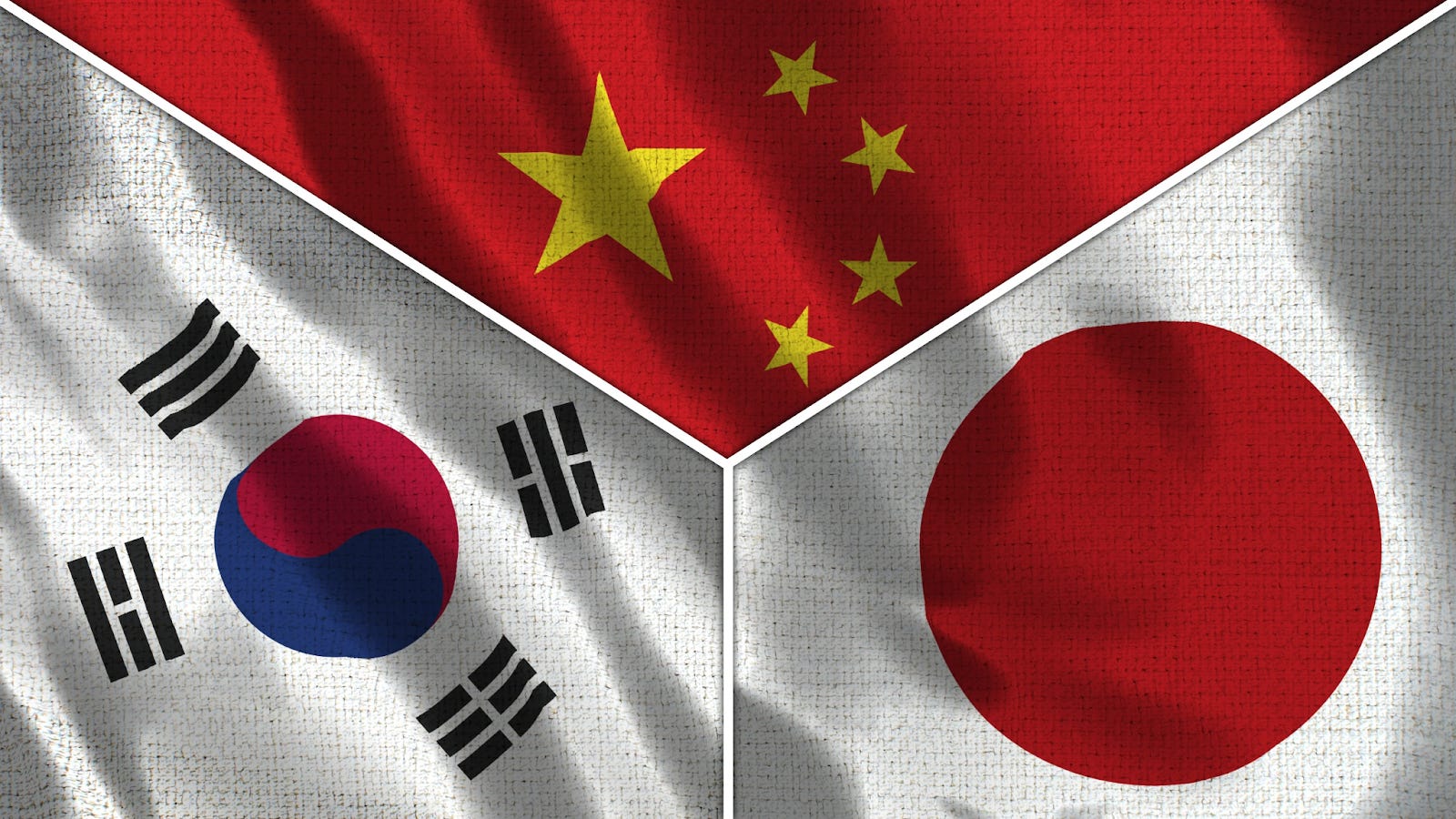
After World War II ended, the U.S. took a major lead in the reconstruction of Japan, and after the Korean War, they came to the aid of South Korea. This support forced the two Asian nations to reconcile their differences for a tenuous peace that has lasted nearly 90 years. However, with the increasing dominance of China in the region and unresolved conflicts between Japan and the Koreas due to colonialism, East Asia’s future is looking more uncertain than ever. To create stability instead of uncertainty, the best course of action is for Japan and South Korea to pursue measures to decouple from reliance on China and the United States because of rising political instability between the two superpowers. This decoupling is necessary to avoid devastating consequences if conflict breaks out or if either superpower experiences further economic decline.
The US created an economic and military dependence for itself with Japan and South Korea after WW2, which created less self-reliant states in the long term. With dependence taken for granted, both Asian nations have been shaken by the Trump administration’s hostile approach to diplomacy. Surprise tariffs and diplomatic dismissal have shaken Japan’s perception of the U.S. and have led to a reconsideration of both national defense and economic stability in Japan without the backboard of American support. In expert interviews, the Brookings Institute reports that Korea may have a forced decoupling from the U.S. as the Trump administration focuses less on maintaining regional stability and more on antagonizing China. This could look like decreased trade, military presence, and possibly even the withdrawal of the “nuclear umbrella” or the assurance of response from the U.S. should North Korea take military action against South Korea.
A study from Political Science Quarterly found that COVID-19 was a tipping point in relational decline between the U.S. and East Asia on the whole. Polls of both Japanese and Korean citizens found strong disapproval for the American government’s handling of COVID-19 protocol; polls of Chinese citizens found similar disapproval ratings and increased distrust of America due to their blaming of China for the pandemic, despite China having far lower infection rates and death tolls comparatively. The Lowy Institute explains that China’s growth overtaking that of the U.S., paired with a second Trump administration, leads to an overall shrinking of U.S. influence in the region. It further suggests that the lackluster response to the Russia-Ukraine conflict has frightened U.S. allies in Asia, leading them to think that they would not receive strong support if conflict broke out, particularly with another Trump administration at the helm. These countries are right to be wary - the current “America First” rhetoric we have been seeing confirms the fears that support of other countries is not America’s top priority. In essence, South Korea and Japan should focus on reducing their political dependence and cultivating more equal alliances with other nations to gain independent benefits.
Concurrently, due to both its close proximity and titanic economy, China has asserted its own dominance in Northeast Asian spheres. The Brookings Institute elaborates that because China is the largest trade partner for Japan and South Korea and supplies many materials for their industries, particularly in technology manufacturing, they would be hesitant to align fully with the United States should conflict arise. However, over the long term, this dependence could sour and leave countries in a lurch as they were left in during COVID-19; wise policy decisions in the near future would take care to avoid overreliance and focus on broadening trade networks to meet economic needs. China is the key trade partner of both Japan and South Korea, but this poses a significant risk, as evidenced by the COVID-19 pandemic, which led to border lockdowns and supply shortages. Additionally, China may impose sanctions with devastating consequences if these two states side with the U.S. in a major conflict. Japan and South Korea should boost local industry and pursue less contentious trade partnerships. According to large-scale analysis, “ The impact of COVID-19 on trade included delays, shortages, and increased transportation costs. These shocks affected both supply and demand. While a few select products benefited from the shocks, most products experienced both a drop in demand and an increase in costs.” In this analysis, Japan’s recession, stemming from lockdowns and slowdowns in Chinese-material-based goods (such as Toyota cars with plastic and metal parts made in China), made a significant dent in the economy. This dent can be tied to dependence on Chinese sources for materials, and it can be hypothesized that having more sources for materials could have lessened the recession’s severity.
This shaky economic situation is only exacerbated by the so-called “Tariff Wars” between the U.S. and China. Diplomatic analysis out of the EU has pointed out that while the U.S. is struggling with the effects of the Trump trade war, South Korea and Japan (as well as other Asian countries) have taken advantage and directly gained more trade as China still seeks to export goods. The trade war extends not only to China but also to the US’s allies more broadly.
A recent development that reinforces American withdrawal from Asia is the early departure of Trump from the most recent G7 meeting in June. This blatant refusal to cooperate with one of the most powerful Asian countries, Japan, marks a clear diplomatic pivot. For the upcoming G20 summit, it will become the G19, according to the East Asia Forum, because America will not be participating. As China is projected to maintain dominance in this sphere, along with other rising powers such as India, this is a sign that U.S. allies cannot rely on the hegemon of yesteryear.
The final question remains: what lies in the future for the East Asian nations with recommended decoupling strategies? Some suggest that U.S. hegemonic decline may lead to democratic backsliding or authoritarianism sponsored by China à la North Korea. However, the more likely outcome is that democracy in East Asia will be just fine. Recent political events in Korea have indicated a strong upholding of democracy without interference from the United States, and Japan continues to work to ensure that parliamentary representation in the country maintains democratic measures despite one party’s dominance in the majority. America, on the other hand, is becoming less democratic. Japan and Korea’s democracies are protecting their economic and military futures by diplomatically decoupling before they are mired in this decline.
Decoupling is not merely a suggestion but has multiple policy suggestions and bases already. The Asia Times prescribes a path for Japan’s autonomy in trade and political spheres: diversify diplomatic relations away from U.S-allied countries, settle affairs with Russia over northern territories to avoid any backlash from Putin in the future, remove or decrease the U.S. military bases centered in Japan that have long been opposed by the public due to abuses by American soldiers, divest from U.S. debt bonds for more profitable investment projects, and work to de-colonize various policies put in place by post WW2 American forces. Japan’s decoupling measures towards China span nearly 15 years; with the conflict over Pacific island territories whipping up a rivalry in 2010, Japan began investing in diversified supply chains and focusing on sanction resilience. If Korea can also diversify its investments and follow through on reducing its military reliance on the U.S., we could indeed see an autonomous Asia not shaped solely by superpower puppetry, but by strong independent states participating actively in global economics and policies following their own free will.