

The Constitution as a Culmination of the “Spirit of 76”
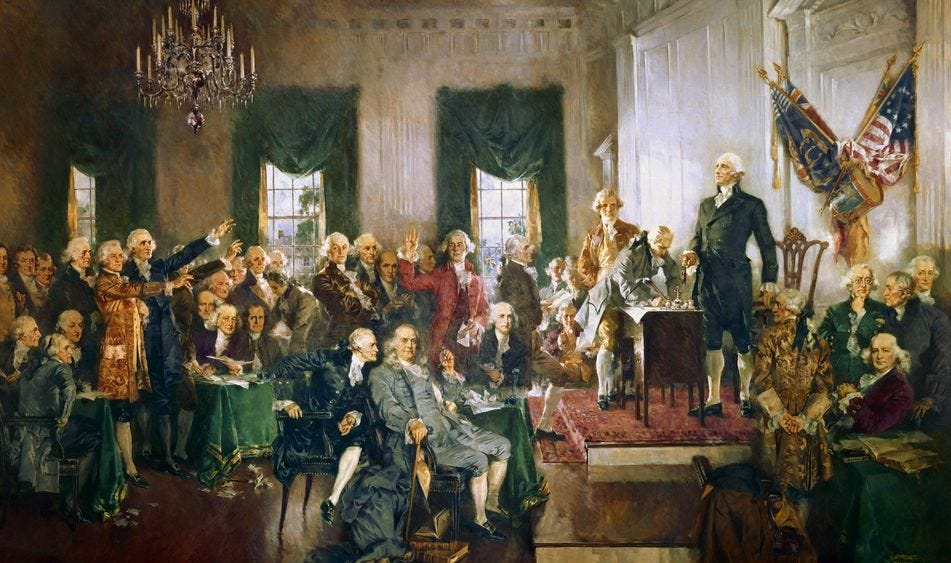
There is a new perspective emerging that the Constitution was nothing but a coup by elites, a coup that betrayed the true sentiments and goals of the American Revolution. Some historians, including Michael Klarman, charge that the Founders created a less democratic system of government to protect their economic interests and preserve their outsized political power. While it is undoubtedly true that the new federal government did not prioritize democracy and public involvement as much as contemporary state governments, we should view this as an effort to safeguard the creation of a free society, the Revolution’s main accomplishment, as opposed to an attempt at personal aggrandizement.
The Aristocracy or the Masses?
At first glance, the text of the Constitution suggests that Klarman’s assertion about the inherent aristocratic self-interest in the Constitution is correct. Some of the core beliefs that we think of as characterizing the revolutionary "Spirit of 76" are repudiated by the Constitution—namely, the move towards decentralized government, the fear of a strong executive, and the adulation of democratic accountability and popular control over elected officials. Article VI's supremacy clause and Article I's powers of congress created a powerful central government. Article II’s vague construction of presidential authority, specifically the declaration that “ the executive Power shall be vested in [the] President,” created the potential for a powerful, unitary executive. Additionally, Article III erected an unelected Supreme Court whose members would serve “during good behavior.” Article I provided that the Senate would be indirectly elected by state legislatures, and Article II provided that the President would be indirectly elected by the Electoral College. Ostensibly, these central provisions of the Constitution are damning proof that the Founders, in practice, renounced the revolutionary mission they extolled in theory—a mission that demanded a weak, decentralized, and democratically accountable government.
However, I contend that the true "Spirit of 76" was rooted in a desire to protect fundamental individual liberties, and the Framers of the Constitution sought to preserve these liberties by creating a system that checked the democratic aspects of the new national government. American colonists in 1776 despised the monarchy imposed on them by the British. They also deplored the all-powerful executives—King George and the royal governors—who ruled over them. This concentration of power, without democratic accountability or popular control, led to repeated infringements upon their rights and liberties. Thus, they resisted centralization and sought a weaker central government and more democratic state governments to insulate them from the tyranny of the monarchy. Mindful of this context, we can see that the Constitution did not abandon its revolutionary spirit in creating a powerful central government, an unelected Supreme Court, and indirectly elected officials; it still preserved what really mattered to the people: the protection of their liberties. Men like James Madison wisely realized that the best way to protect fundamental freedoms was to strike a balance between the government of imperial Great Britain and the radically democratic governments established by some states, Pennsylvania being the best example.
The Constitution’s Healthy Median
The Constitution retained many elements of democracy. For instance, representatives in the House were still directly elected and the preamble specifically proclaimed that "We the People” were the creators and benefactors of this new government. Additionally, popular sentiments and votes still influenced the election of Senators and the President and, in a more indirect way, also influenced the Supreme Court. However, the men at the Constitutional Convention realized that a partly undemocratic structure would better safeguard our rights through limitations on powers, bicameralism, federalism, and the separation of powers.
By creating a national government that checked itself and was limited in its control over the states, the Framers created an environment in which political stability and the protection of rights could be achieved on the national level, where the risks of majoritarianism were higher, while still permitting states to exercise substantial control over their own affairs. States would be the place where democratic principles could remain paramount.
Nonetheless, the Framers also knew that a purely unelected or aristocratic government would surely lead to the deprivation of rights. As such, they created a government that was neither too democratic nor too aristocratic. This is what Madison meant by his famous quote in Federalist No. 10:
“In the extent and proper structure of the Union, therefore, we behold a Republican remedy for the diseases most incident to Republican Government.”
The structure outlined in the Constitution was designed to prevent the harmful elements of strictly republican government from coming to fruition while preserving and empowering its positive features. The Constitution is a document that embodies compromise and wisdom. The careful balance that it struck was a profoundly successful one, as it has survived for 245 years as the Supreme Law of Our Land. If the true "Spirit of 76" was a sincere desire to create a durable government that would protect our rights well into the future, it is clear that the Constitution was the culmination of that sentiment.
Further evidence that the Constitution represented the climax of the revolutionary spirit is seen in the ratification debates and the Bill of Rights. Anti-Federalists fought hard to add a Bill of Rights to the final document, just as they had fought against England, because they felt that the protection and preservation of fundamental rights should be the government’s chief duty and purpose. The Bill of Rights provides us with ample proof of the Constitution’s concern with defending American citizens from governmental encroachments. Each of the first ten amendments address and expressly protect rights that were valued and fought for by Americans throughout the Revolution, and many of the amendments were directed at specific infringements by the British government.
The 1st Amendment's guarantee of a right to petition the government had been outlined in the Magna Carta and the English Bill of Rights. The 2nd Amendment enshrined into law the importance of the militia and of firearm possession by the people, a lesson learned before and during the Revolution. The 3rd Amendment's protection against coerced quartering of soldiers in homes arose from the Quartering Act in the pre-revolutionary period. The 4th Amendment's defense against unreasonable searches and seizures drew inspiration from warrantless searches by British officials who operated under broad writs of assistance. The 5th Amendment’s protection against self-incrimination sought to prevent the kinds of injustices carried out by courts in the Star Chamber. The 8th Amendment's safeguard against cruel and unusual punishment was a reaction to the infamous case of Titus Oates. The language of the Bill of Rights clearly reflects that the new Federal Constitution, by 1791, declared and secured fundamental rights in a way that the Articles of Confederation did not and represented the apex of the American Revolution.
In Closing
While it is undeniable that the Constitution created a stronger central government than the Articles of Confederation did, and that it did not respect democratic considerations as well as many state constitutions, the document is nonetheless faithful to the Revolution. Its provisions and structure were intended to protect and preserve our liberties, and many of those liberties are even expressly outlined and protected by the Bill of Rights. There is a reason why there were never again serious calls to return to the Articles of Confederation, and it certainly wasn’t because the Founding Fathers used the document for personal gain. Rather, the success of our Constitution is predicated on James Madison and the Founding Fathers’ striking the perfect republican balance within it—a balance that encapsulated and preserved that enduring “Spirit of 76.”